Wednesday, 11 August 2010

Dispersion of Scotland's Population

In his comments on our interim report, Alan Arnott noted our statement that,
“Over 10% of the population of Scotland lives in population densities greater than 10,000 people per km2, while the least accessible 15% live at densities of less than 1000 people per km2."
He commented that,
the UK has an overall population density of around 350 people per km2 with Scotland around 65/km2 so the above figures seem somewhat inflated.
We based our analysis on the Census 2001 data for "output areas" (OA). Our interim report attempted to summarise the contrast between the dense cities and sparse hinterland. The figures we gave are correct, but rounded.
In fact over 11.0% (but less than 11.1%) live at densities over 10,000 p/km2. The least accessible 14.6% live at densities < 1,000 p/km2. The least accessible 15% live at densities < 1,070 p/km2. Instead of rounding the percentage, we should have rounded the population count and said, "while the least accessible 15% live at densities of less than 1100 people per km2".
However, the comment prompted us to return to make a finer comparison with England, with a surprising result.
The population densities averaged over each country are Scotland 65 p/km2; England 377 p/km2. One might naturally expect this to imply that, in general, people in Scotland live at much lower population densities than people in England. This is not the case.
At a local level, 90% of the population of Scotland lives at population densities at least as high as those in England!
There are 46,604 output areas in Scotland, and 165,665 in England. The "Key Statistics" table gives area (A) and population (P) for each output area.
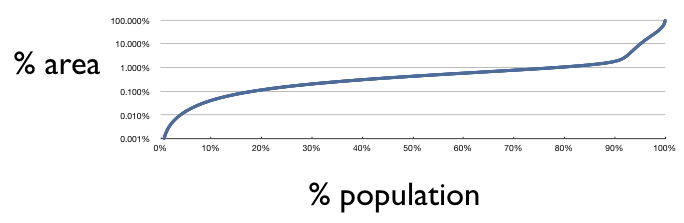
We calculate population density for each output area (as the quotient P/A), and list the output areas in order of decreasing population density. The cumulative percentage of population included in initial segments of this list is used as abscissa (x-axis) in the graphs below (click on the graphs for larger images).
Our interim report included this plot: Area Occupied by Scotland's Population It shows, for each x, the percentage of the area of Scotland occupied by the most densely housed x% of the population, with the area shown on a log scale.
To compare the population densities in Scotland and England, we plot two new graphs (below) of population density. In each case we use a log scale, and units of people per hectare (for p/km2, multiply by 100). The data for England (green) are compared with those for Scotland (blue).
The upper graph plots the population density for each output area against the cumulative centile within which its population falls. For the first 90 centiles of population from each country, those in Scotland live at marginal densities at least as high those in England. Scotland has many small communities, often packed more densely than their counterparts in England. So "last mile" solutions that work in England should be applicable also to communities in Scotland. The lower graph plots the "cumulative density", computed as the quotient, cumulative population/cumulative area. This shows how the gap between the overall figures of 65/km2 for Scotland and 377 p/km2 for England as a whole arises because the last 10% of the population is much more sparsely distributed in Scotland than in England.
What these graphs do not show is that many of Scotland's communities are widely separated. The "middle mile" connections required to bring broadband to these communities are a particular concern.

Thursday, 15 July 2010

Broadband target pushed back ...

Culture minister Jeremy Hunt today announced that the 2Mb/s by 2012 target, which he had previously dismissed as unambitious, was unachievable. He said the target will have to be pushed back to the end of the current Parliament in 2015.
He still said Britain should have “the best broadband network in Europe by the end of this parliament”. Meanwhile, Finland's target for 2015 is for 100 Mb/s. Ours will not compete. Broadband speeds, worldwide, are expected to continue to grow – 8-fold in 5 years, 64-fold in 10. Just as a five-year-old computer has a hard time coping with today's applications, so a broadband speed of 2Mb/s in 2015 will seem as inadequate as a speed of 256 Kb/s does today.
It is worthwhile looking in more detail at the targets. How can we fall so far behind? Britain's focus is on the date by which every home will have a 2 Mb/s service. Finland concentrates on the core infrastructure. Its target is to ensure that fibre backhaul sufficient to accommodate 100Mb/s service is available within 2 km of every home and business. The presumption is that, once this is done, market forces will provide the "last mile" connection to the home. Rutland Telecom's success demonstrates that this could also happen in Britain, where suitable backhaul is available. Our national strategic target should be to establish the core infrastructure – the rest can follow through a combination of market provision and local initiatives.
Fibre must come within reach of every home and business (within 2 km for wired connections; within 30 km or more for small communities that con be connected by wireless links). This is an essential prerequisite for sustainable provision of broadband speeds that keep pace with those enjoyed by our competitors. In Singapore, which has a much greater population density, 1 Gb/s fibre to the home is being installed today.
Our strategic planning should concentrate on the development of this core fibre network. A fibre cable is as cheap as copper to lay, and can provide ten thousand times the bandwidth. It requires less maintenance and has an expected lifespan of over 30 years.
Hunt's calls for effective use of capacity in existing networks, and for exploitation of sewers and roadworks to reduce the costs of laying new fibre are welcome. To address the growing digital divide, we also need a strategic review of current fibre infrastructure, cooperation and open access to maximise the effective use of this infrastructure, and targeted investment to bring fibre to areas currently out of reach. This investment should be stimulated by removing – for shared-access passive infrastructure – obstacles such as business rates on fibre and masts, and Crown Estate levies on sub-sea cables.
Today's announcements gave no hint of a strategic plan. The issues of next-generation rollout are well-studied. Reports such as Alcatel-Lucent's Fibre Nations white paper (2008) set out clear challenges to governments. Unless these are addressed we will continue to fall further behind.
Our interim Digital Scotland report provides more detail, and your comments are welcome.

Wednesday, 30 June 2010

Interim report open for consultation

Michael Fourman presented the interim report today to the cross-party group for Science and Technology at the Scottish Parliament.

Monday, 1 March 2010

Digital Scotland Consultation

Update 23 June 2010 if you wish to comment on the draft consultation report, please use the comments section below this post. The consultation document will be launched on Wednesday 30th June.
Please comment on this and earlier posts to contribute to the development of a Digital Strategy for Scotland.
The development of digital society is changing the ways we live, work and play. These changes are global, but local action is required to maximise local benefit.
Scotland needs a Digital Strategy to remain competitive in a rapidly changing world. This should enable local enterprises to participate in the global digital economy, include local communities in the global digital society, and allow Scotland to exploit new opportunities — afforded by current and future technologies — for innovation in devolved areas of government.
To contribute to the factual basis on which such a strategy must be built, we will survey four major areas and conclude with our recommendations:
  1. Users and benefits
    • How may different communities be affected by digital society?
    • To include communities of interest as well as geographic communities.
    • To include business sectors as well as social groups.
    • To assess the benefits digital inclusion may bring.
  2. Infrastructure
    • Geography and demographics
    • Installed capacity
    • Technology survey (copper, fibre, wifi, satellite, etc.).
    • Technology foresight - five-year/ten-year.
  3. Content and access
    • Consider how Scottish policy may affect re-use of public-sector information in devolved matters (including, e.g. education, health, government).
    • Public access – schools, libraries, parks.
  4. Comparators
    • We will consider a range of international comparators matched for demographics and geography, to see how both policy and practice elsewhere might inform a Scottish strategy.
  5. Recommendations
    • Our recommendations for policy and action will be founded on the evidence gathered in earlier sections.
    • We will gather, and invite comment on policies and actions being proposed and adopted elsewhere, as well as novel suggestions for the Scottish context.

We invite public contributions to help us both shape and answer the questions we will address under each of these headings. We intend this to be a flexible process.
Each of the five headings above is linked to its own page, where you will find more detailed questions and discussion.
In the first instance, please contribute by commenting on the appropriate page (for general suggestions on content and process please comment on this page).
All comments will be moderated – please, no spam: spam will be rejected. Please indicate in what capacity you are writing. Indicate clearly any parts of your message not intended for open publication (private messages for the committee or personal contact details). 
Always assume that participation online results in your comments being permanently available and open to being republished in other media. Be aware that libel, defamation, copyright and data protection laws apply.

Digital Scotland: Users and benefits

We will identify groups, activities and communities that will be affected by Scotland's Digital Strategy. These will include communities of interest as well as geographic communities, and business sectors as well as social groups:
  • Commerce
  • Entertainment
  • Farming and fishing
  • Tourism
  • Education
  • Health
  • Government
We will assess, and where possible quantify, the requirements of different groups and the benefits digital inclusion may bring.

Economic framework


We hope to demonstrate that:
  • Broadband is not only the web and email—it's also a radio, a tv, a daily newspaper, a library and a town hall.
  • Digital infrastructure contributes to education, health care, energy, public safety, and democratic engagement.
  • It supports collaboration and innovation, and provides producers and entrepreneurs with access to global markets.
  • It makes remote communities more sustainable, and supports social inclusion.

Please add your comments and contributions below.
All comments will be moderated – please, no spam. Please indicate in what capacity you are writing. Indicate clearly any parts of your message not intended for open publication (private messages for the committee or personal contact details). 
Always remember that participation online results in your comments being permanently available, and open to being republished in other media. Be aware that libel, defamation, copyright and data protection laws apply.

Digital Scotland: Infrastructure

We will identify the capabilities of current and future technologies that may contribute to Scotland's digital infrastructure, and examine their applicability in relation to Scotland's geography and demographics.
  • Geography and demographics
    • Urban Scotland
    • Rural Scotland
    • Suburban Scotland
  • Current and planned provision
  • Technology summary
    • Fibre
    • Copper
      • POTS
      • Co-ax
      • Power Line
    • Wireless
    • Satellite
  • Technology forsight
    • Computation
      • Moore's Law
    • Communication
      • Nielsen's Law
    • Data
      • The Data Deluge

Please add your comments and contributions below.
All comments will be moderated – please, no spam. Please indicate in what capacity you are writing. Indicate clearly any parts of your message not intended for open publication (private messages for the committee or personal contact details). 
Always remember that participation online results in your comments being permanently available, and open to being republished in other media. Be aware that libel, defamation, copyright and data protection laws apply.

Digital Scotland: Content and access

We will consider how Scottish policy may affect re-use of public-sector information in Scotland — in particular, in devolved matters (which include, e.g., education, health, government).
What barriers exist to universal digital inclusion in Scotland?br /> What opportunities may be provided for public access – e.g. through schools, libraries, community meeting places and parks?
We invite contributions to help us both shape and answer the questions we will address.
Please comment below.
All comments will be moderated – please, no spam. Please indicate in what capacity you are writing. Indicate clearly any parts of your message not intended for open publication (private messages for the committee or personal contact details). 
Always remember that participation online results in your comments being permanently available, and open to being republished in other media. Be aware that libel, defamation, copyright and data protection laws apply.

Digital Scotland: Comparators

This section will benchmark a selection of local initiatives and international comparators, in order both to learn from practice elsewhere, and to identify the plans and capabilities of our present and future competitors.
Please add your comments and contributions below.
All comments will be moderated – please, no spam. Please indicate in what capacity you are writing. Indicate clearly any parts of your message not intended for open publication (private messages for the committee or personal contact details). 
Always remember that participation online results in your comments being permanently available, and open to being republished in other media. Be aware that libel, defamation, copyright and data protection laws apply.

Sunday, 28 February 2010

Digital Scotland: Recommendations

Our final report will include recommendations for policy and action. These will be founded on the evidence gathered in earlier sections.
The draft recommendations listed below may be amended in the light of further evidence.

Draft recommendations

  1. An integrated backbone providing universal access should be developed as strategic infrastructure for Scotland.
    This could be achieved by a combination of FTTC (fibre to the cabinet) in built-up areas, with sparser fiber provision supplemented by wireless distribution, in less-populated areas.
  2. Regulation should be made to require open data on core infrastructure and competitive access to nodes and ducts.
    This will enable innovation and the development of local community broadband in areas of market failure.
  3. All future transport infrastructures and urban developments should be pre-installed with tubes into which optical fibre may later be installed, or ”blown”, as a planning requirement.
  4. Open internet access should be provided, in schools, libraries, community centres etc., to support digital inclusion.
  5. A standard open licence for public data should be adopted and used.

Recommendations made elsewhere

  1. Install broadband fiber as part of every federally-funded infrastructure project.
  2. Deploy broadband fiber to every library, school, community health care center, and public housing facility in the United States
  3. Create incentives for providers to install multiple lines of fiber as new networks are rolled out.
  4. Encourage greater wireless broadband and reduce barriers to deployment.
  5. Vouchers to allow low-income students to get broadband Internet service at their homes.
These are taken from various sources, including Google's suggestions for US national bb plan.
We invite your comments on applicability to Scotland of the recommendations listed above and your contributions to help us formulate and shape our own recommendations.
Please comment below.
All comments will be moderated – please, no spam. Please indicate in what capacity you are writing. Indicate clearly any parts of your message not intended for open publication (private messages for the working group or personal contact details). 
Always remember that participation online results in your comments being permanently available, and open to being republished in other media. Be aware that libel, defamation, copyright and data protection laws apply.

Thursday, 14 January 2010

Second meeting

The RSE Digital Scotland Working Group met today.

It was agreed that Professor Michael Fourman would be the chair of the working group.

A draft scoping paper that had previously been circulated was discussed and a number of comments and suggestions made - these will be taken on board and a revised scoping paper, suitable for briefing organisations and individuals we wish to consult, will be circulated.

To help frame the questions for consultation, we will build the framework of issues that the final report may be expected to cover, and perhaps to identify some areas that it would not be feasible or worthwhile to address in the course of this work.

The two pieces of work identified above will be completed before the next meeting of the group, on 10th February. Interviewing of witnesses and gathering of evidence will commence after this meeting.