Showing posts with label fibre. Show all posts

Saturday, 12 May 2012

How close is the fibre to you?

If your broadband connection is delivered down your copper 'phone line, your speed is fundamentally limited by the length of the line to the exchange (or where BT has rolled out FTTC, to the cabinet). Exact performance depends on many factors, but there is a fundamental inverse square law, and typical limits are of the order of 300m for 100Mb/s, 1km for 10Mb/s, 3km for 1Mb/s.

Some 85% of homes in the UK have more than 800 neighbours within 700 metres. We build maps that highlight such compact communities that are far from fibre. For example, most of Porthleven is more than 3km from the nearest exchange, as are substantial parts of East Kilbride, Nitshill and Hartlepool (these links should open in a new tab).

Google maps will only show a small number of hotspots at a time – and there are thousands of them. To explore your area, you can examine our hotspot maps on Google Earth, which can cope with large data sets. Clicking on the link should download a .kml file that can be opened in Google Earth. In Chrome, you can instruct the browser to "Always Open Files of this Type", or just open this one. For more detailed instructions see below.

The hotspots on these maps are likely to be not-spots. Hopefully many of these areas will be served by FTTC, and we'll be happy to update the maps if someone can provide positions of FTTC cabinets - or any other NGA provision.

If, however, you live in a hot not-spot, you should find out what plans there are to bring fibre to your community. You won't get NGA (say > 20 Mb/s) over more than 1km of copper
phone line - and for 100Mb/s speeds your copper ration is < 400m. You can see what BT's 'Superfast' Broadband plans are (as of April 2012) by clicking on the pin representing each exchange.


If you live in a less-densely populated community (with fewer than 800 neighbours within 700 metres) then you might want to plan a community network to bring NGA to your homes and you should be asking where you can access affordable fibre backhaul nearby.

Caveats

Our distance computations were based on Sam Knows data, from which some exchanges are missing - so in a few instances you may find an exchange marked inside a 'hotspot'. The Open Reach data does not always plot the exchanges accurately. Some are a few hundred metres from their true positions. The Sam Knows data has similar (but different) errors.

Because there is no publicly available dataset of cabinets, we cannot plot your distance from the cabinet. Likewise, we have no data on the Virgin network. You may be getting superfast access from within one of our hotspots – in which case lucky you! Do let us know, in the comments below.

More detail

When you import the .kml file into Google Earth, you should see a new entry appear in the GE sidebar. Zoom in to your area of interest. Once you zoom in far enough your local exchanges should appear. Click on the 'pushpin' to see BT's plans for SFBB at this exchange.

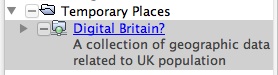
Click on the triangle to open the 'Digital Britain?' folder.

Open the 'Compact Communities' folder to see, and select, the various heatmaps available.


Sunday, 24 October 2010

Digital Scotland Report to be published on Tuesday 26th


Press release: embargoed to Sunday 24 October 00:01 
21 October 2010
RSE calls for Scotland to take urgent and innovative action on broadband.
“Communication is the life blood of society. Scotland’s future depends on having in place an effective digital infrastructure that will underpin a successful economy, vibrant culture and strong communities” explains Professor Michael Fourman, chair of the report ‘Digital Scotland’ that will be published by the Royal Society of Edinburgh on Tuesday 26 November.
“But when it comes to delivering access to high speed broadband, Scotland is falling behind its international competitors, and so will fall behind in all areas in which high quality communication is vital: the economy, health, education, the delivery of public services and social interaction.”
Following consultation with industry players, community groups, regulators and government, Professor Fourman and his team are calling for urgent action at a Scottish level to increase the volume and speed of access to the internet across the country. “Scotland must take the lead in developing its own digital infrastructure. We should not, and cannot, rely on the UK Government to deliver this for us. The Scottish Government and Scotland’s local authorities must work together to drive forward the digital agenda as they are the bodies that hold many of the levers to do so, such as planning regulations, procurement and business rates.”
Digital Scotland sets out a comprehensive plan for the creation of a core fibre infrastructure that would bring high speed broadband within reach of all of Scotland’s communities: urban, sub-urban and rural. It calculates the capital cost required to ensure that all of Scotland can keep up with the global pace of development over the next few decades at around £100 million. For reasons of social inclusion and equality of opportunity, Scotland cannot afford a widening digital divide. The report proposes that this enterprise could develop as a distinctively Scottish community effort, bringing benefit to the whole of Scotland, with innovative funding options that need not call on the public purse.
The working group recommends that a Digital Scotland Trust be established to raise finance, procure, operate and maintain the core digital infrastructure in the national interest. It calls for an optic fibre backbone, akin to the trunk roads of our transport network, to be created, that will bring next-generation speeds to a nationwide network of digital hubs from which community networks and service providers can connect to the global internet. And it recognises the need for social hubs, where internet access is available to all, in libraries and other community centres, and where support is available to groups who would otherwise be excluded from digital society.
Geoffrey Boulton, General Secretary of the RSE, comments “As with the industrial revolution two hundred years ago, we are now caught up in another technology-enabled global revolution of possibly similar magnitude. The coupling of new digital technologies that permit acquisition and manipulation of massive amounts of information with devices that put instantaneous communication in the hands of all, is again revolutionising the global economy and social, political and personal relationships. It is a revolution that has not yet run its course. It has both benefits and dangers, and its ultimate trajectory is uncertain. What is not uncertain is the need for Scotland to be at the forefront of this revolution as it was in the 19th century.”
“Good internet access is crucial to our competitiveness in global markets and the survival of our local communities,” Professor Fourman continues, “The pace of chance is likely to quicken rather than falter, which itself will create many challenges because, as recent history has shown, the trajectory of technological development is likely to be unpredictable, as will many of the uses to which it will be put. We are confident, however, that continuing advances in digital technologies will produce further benefits for society.”
Broadband communication offers dramatic increases in economic efficiency through reduction of transaction costs, and the opening of access to global markets. These come hand in hand with advances in data collection and analysis, improved user engagement provides real time customer feedback. Improved decision making reduces the reaction times of businesses in responding to threats and opportunities, claims the report. 
And it’s not just about business. The social benefits are enormous – enhanced broadband capacity increases social interaction in communities, opening up more opportunities and greater flexibility at work and in leisure. Both consumers and producers benefit from a more efficient economy. More people have the opportunity to contribute to the workforce. Rural areas excluded from the modern economy can now engage. Parents staying at home to raise children can work flexibly from home. 
The web has revolutionised social interactions amongst the young in particular. Social networking sites, pervasive communication and ready access to information and knowledge through instant search are not an integral part of the social structure of modern life. In the USA for example 17% of couples married in the past 3 years first met on an online dating site. 
Information technology is also providing a powerful stimulus to the strengthening of civil society, in which many hopes were invested at the time of parliamentary devolution. Digital systems have the capacity to enhance the delivery of public services at a reduced cost in health, education, social services and other areas of government responsibility. 
Lack of infrastructure capacity limits the provision of local access, the delivery of next-generation speeds to homes and businesses, and the rollout of mobile data services. The Digital Scotland group welcomes BT’s work to extend its fibre to more exchanges; and the announcement on 20 October that the Highlands and Islands have been successful in securing one of BDUK’s three rural broadband pilot projects which will be delivered in conjunction with the BBC.  The important point is to ensure that this delivers open access to affordable backhaul at fibre speeds. These initiatives will reduce the scope and lower the cost of the programme required.
The report is already receiving widespread support. 
Influential Scottish businessman Sir Angus Grossart commented “This report should be implemented. It will be a potent lever to liberate and develop the abilities and potential of Scotland, at a low cost. The enhancement of our communications infrastructure will have a transformational effect, across the widest areas of activity and geography.”
David Cairns, Chair of ScotlandIS welcomed the report, explained “A world class communications infrastructure is essential if we are to give Scottish entrepreneurs the ability to address global markets.  It is also essential to be internationally competitive in the 21st century.  The opportunity is exciting, but if we fail to seize the day we also face the threat of a weakening competitive position because others are not standing still.   ScotlandIS welcomes this report which sets out a practical, affordable plan to deliver a future proofed digital infrastructure for all Scotland's communities, businesses and public services.”
Jeremy Peat, BBC Trustee for Scotland, commented “I very much welcome this thoughtful report and wholly agree with the importance of spreading access to high speed broadband across Scotland  - and encouraging its take up. I would note, regarding take up, that the reasons for low broadband take up in West Central Scotland also merits attention.”
http://bit.ly/digiscot
http://twitter.com/digiscot
http://digital-scotland.blogspot.com
ENDS
This information and further details/interview arrangements from:
Susan Bishop, RSE
sbishop@royalsoced.org.uk
0131 240 2789
07738 570 315
Or 
Carol Anderson
The Business
0131 718 6022
07836 546 256

Friday, 22 October 2010

Scotland's Broadband Strategy 2001-2010

only the numbers have changed

Scotland has a problem
"the issue of the lack of trunk capacity is a real constraint on the promotion of economic development in island and remote rural areas, ....  island and remoter links are not robust"

Scotland has a broadband strategy – dating from 2001. In this post we look to see what has changed over the past decade. Short synopsis: nothing has changed but the numbers.


The 2001 strategy considered the backhaul requirements for five small towns. The speeds from 2000 look quaint (but remember, that even today the 26,000 population of the Western Isles shares one 34 Mb/s connection to the internet).

To adapt one of the key findings of the Digital Scotland working group to the language of the 2001 strategy, our Digital Scotland report finds that every 1,000 people require a backhaul bandwith of 32 Mb/s (at 25:1 contention, for 400 subscribers) to achieve subscriber speeds of 2 Mb/s – we argue that this is the minimum speed required for "functional internet access" in 2010.

By 2015, median speeds will have increased eight-fold. The minimum speed, available to all, should rise similarly, to 16 Mb/s, at which point a community of 1,000 will require 256 Mb/s of bandwidth. We should plan beyond that, for universal speeds of 128Mb/s in 2020.

Taking the 2000 populations, for ease of comparison, We see that each of these towns will require gigabit backhaul before 2015. This requires fibre. 
This why we recommend that every community of 2,000 people should have access to a fibre backhaul connection by 2015. Only fibre can provide the bandwidth required, just to satisfy the private demand.

The good thing is that once fibre reaches a community the backhaul issue will be resolved for decades to come. A single fibre can carry over 100 channels using different colours of light, and each channel can carry 100 Gb/s. Installing surplus fibre is cheap, so we can invest for the future as we provide for the present.

We must act now. Already many parts of Scotland cannot improve their internet connectivity for want of backhaul, and providers cannot extend mobile broadband coverage to many parts of Scotland for the same reason.


The primary aim first stated in 2001 has stood the test of time. It should still be the foundation for a strategy for the present:
  • to make affordable and pervasive broadband connections available to citizens and businesses across Scotland
We should still
  • ensure that every school has access to a rich online world in which it will be possible to communicate with others by text, voice or video.
  • ensure that all parts of the health service can transfer data and use telemedicine as necessary.
  • ensure that all local authorities can provide modern, customer focused services.
And public sector procurement is still a vital tool
  • Our objective is that, by providing broadband to the public sector, we stimulate providers to offer a wider range of services to business and individuals.
It is still true that
  • Higher bandwidth facilitates high volume data transfer and certain applications, such as video-streaming and concurrent design. If we are to have world-class education, world- class health services and globally competitive business, it will be vital that the latest applications can be used and for this we need “always on” broadband.
  • To be world-class, we need to be at the leading edge in the use of ICTs. That will require action to promote use, supplementing the stimulus of competition and the market.
  • Demand is important, but the market does not always respond quickly enough. Therefore the focus of this paper is how we ensure that when demand exists, services can be supplied.
In short, we need a world-class broadband telecommunications infrastructure.
We still find it difficult to plan because, "None of the maps of telecoms trunk and local networks in Scotland are either comprehensive or definitive. This is because firstly, this information is very largely commercial-in-confidence and secondly, the network is constantly evolving."
We still find that the issue of the lack of trunk capacity is a real constraint on the promotion of economic development in island and remote rural areas, and that island and remoter links are not robust. 

It is still the case that Monopoly provision persists in rural and remote areas. The 2001 concern about whether it will achieve future widespread commercial provision of broadband services to meet anticipated demand, has given way to certainty that it will not.

The key challenge remains: how to build on existing network strengths whilst addressing the shortcomings of the existing infrastructure, particularly in rural areas.